

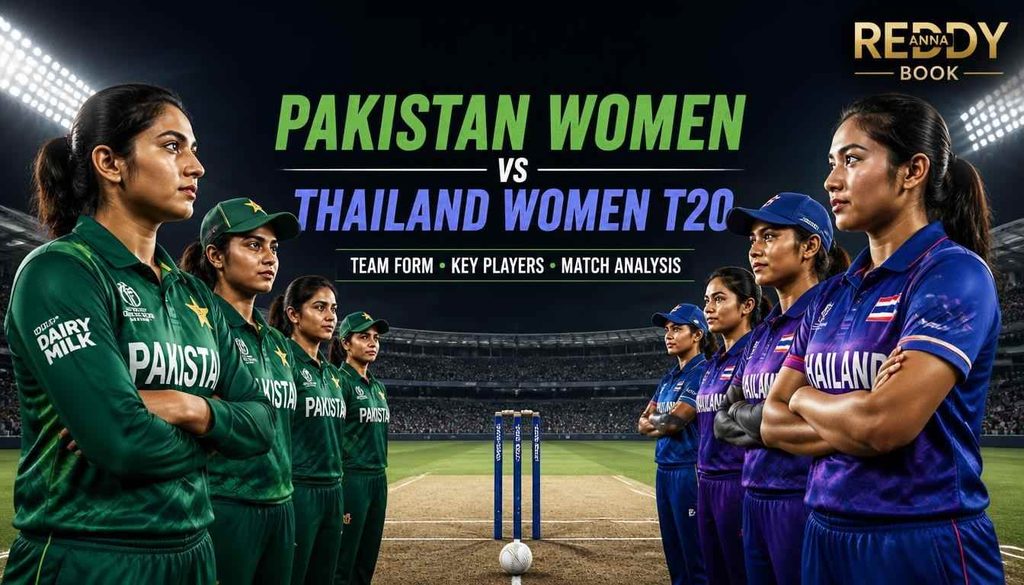
The Pakistan Women vs Thailand Women T20 matchup in the Women’s Asia Cup 2026 produced an interesting contest between two teams with different approaches to T20 cricket. Pakistan brought greater international experience, while Thailand entered the game with a disciplined bowling attack capable of putting pressure on established batters.
Pakistan eventually secured a 35-run victory after scoring 119/9 and restricting Thailand to 84/8. Muneeba Ali’s half-century gave Pakistan’s innings stability after an early setback, while Sadia Iqbal’s three-wicket spell helped Pakistan control the chase.
For readers following women’s cricket and looking for more cricket-related information, Reddy Anna Cricket Betting resources can also provide additional sports and cricket-related coverage.
This Pakistan Women vs Thailand Women T20 match analysis examines recent form, batting and bowling strengths, powerplay and death-over performances, key player matchups, turning points and the major tactical lessons from the game.
Pakistan Women vs Thailand Women T20: Recent Form
Recent form is an important part of understanding any T20 matchup. Results alone do not always explain how a team is performing because batting collapses, bowling spells, pitch conditions and match situations can all influence the final score.
Pakistan Women Recent Form
Pakistan Women entered the Women’s Asia Cup with a mixture of positive performances and difficult results.
During the 2026 ICC Women’s T20 World Cup, Pakistan recorded a 37-run victory against the Netherlands after defending 126/6. Ayesha Zafar contributed with both bat and ball, scoring 32 runs and taking three wickets.
Pakistan also experienced challenging results during the tournament, including a defeat against Bangladesh. Bangladesh’s spin attack created significant pressure and demonstrated how Pakistan’s batting can be tested when scoring opportunities become limited.
Against Thailand, Pakistan once again experienced an early batting problem. They lost two wickets for just seven runs before Muneeba Ali and Sadaf Shamas began rebuilding the innings.
That recovery became one of the most important parts of the match.
Readers interested in understanding account and cricket-related options can also explore the Reddy Anna Online Cricket ID page for additional information.
Thailand Women Recent Form
Thailand Women entered the match after facing India in their opening Women’s Asia Cup fixture.
India posted 159/9, but Thailand’s bowlers showed their ability to create pressure. Suleeporn Laomi claimed three wickets, while Sunida Chaturongrattana took two wickets.
Thailand’s bowling performance was particularly encouraging because they managed to trouble India’s batting lineup during the middle overs.
Against Pakistan, however, Thailand needed to combine that bowling discipline with a stronger batting performance during the chase.
Pakistan Women vs Thailand Women T20: Batting Comparison
| Area | Pakistan Women | Thailand Women |
|---|---|---|
| Top Order | Experienced international batters | Aggressive but developing unit |
| Middle Overs | Partnership building | Strike rotation important |
| Boundary Hitting | Stronger finishing options | Needed greater acceleration |
| Chase Management | Successfully defended total | Required faster scoring |
| Major Challenge | Recovering after early wickets | Maintaining required run rate |
Pakistan Women Batting
Pakistan’s batting innings was defined by recovery.
Thailand’s Thipatcha Putthawong immediately created pressure by taking two wickets in the opening over. Pakistan were reduced to 7/2, putting their middle order under pressure.
Muneeba Ali and Sadaf Shamas responded by building an important partnership.
Instead of attempting aggressive shots immediately after the early wickets, Pakistan focused on rebuilding their innings. That approach helped them reach 60/3 at the halfway stage.
Muneeba eventually scored 54, providing the foundation for Pakistan’s total.
Late contributions from the lower order helped Pakistan reach 119/9.
The innings showed the importance of partnership building in women’s T20 cricket. A team does not always need a huge powerplay score if it can recover effectively through the middle overs.
Thailand Women Batting
Thailand’s chase was difficult from the beginning.
Sadia Iqbal struck early and prevented Thailand from establishing a strong opening partnership.
Natthakan Chantham and captain Naruemol Chaiwai attempted to rebuild the innings, but the scoring rate remained below what was required.
As the required run rate increased, Thailand had to take additional risks. Those risks created further opportunities for Pakistan’s bowlers.
The eventual total of 84/8 reflected Pakistan’s ability to maintain pressure throughout the innings.
Bowling Comparison
Pakistan Women Bowling
Pakistan’s bowling attack played a central role in the victory.
Sadia Iqbal was particularly effective with the new ball and eventually finished with three wickets for 11 runs.
Tuba Hassan also contributed with two wickets.
Pakistan’s spinners were able to control the middle overs, making it difficult for Thailand to score boundaries consistently.
Their bowling approach involved:
- Taking early wickets
- Restricting scoring opportunities
- Using spin effectively
- Maintaining pressure during the middle overs
- Preventing a late acceleration
For readers interested in the wider sports-betting environment, the Reddy Anna Sports Betting section can be linked here naturally without interrupting the cricket analysis.
Thailand Women Bowling
Thailand’s bowling was one of the strongest aspects of their performance.
Thipatcha Putthawong took three wickets for 18 runs and made an immediate impact by removing two Pakistan batters in the first over.
Suleeporn Laomi also claimed three wickets for 14 runs.
Laomi’s spell was particularly important because she removed Sadaf Shamas, Fatima Sana and eventually Muneeba Ali.
Despite taking six wickets between them, Thailand could not completely restrict Pakistan because of the recovery and late contributions from Pakistan’s batting order.
Powerplay Performance
The first six overs created pressure for both teams.
Pakistan Women’s Powerplay
Pakistan’s powerplay was difficult.
Losing two wickets for seven runs gave Thailand early control.
Putthawong’s opening spell demonstrated the effectiveness of attacking Pakistan’s top order with spin.
However, Pakistan avoided further damage by shifting towards partnership building.
Muneeba Ali and Sadaf Shamas helped stabilise the innings, allowing Pakistan to reach a more competitive position by the halfway stage.
Thailand Women’s Powerplay
Thailand also struggled during the opening phase of their chase.
Sadia Iqbal’s early wickets prevented Thailand from building momentum.
Instead of having a comfortable platform from which to accelerate, Thailand had to rebuild while also keeping up with the required run rate.
This difference between the two innings became important later in the match.
Pakistan were able to recover from their early collapse, while Thailand could not produce a similar recovery during their chase.
Death-Overs Performance
Death overs can dramatically change the outcome of a T20 match.
Pakistan’s lower order contributed valuable runs towards the end of their innings and pushed the total to 119/9.
Although 119 was not an extremely high score, it became increasingly valuable because Pakistan’s bowling attack was able to exploit the conditions.
Thailand required a significant acceleration during the final overs but could not find enough boundaries.
Pakistan’s disciplined bowling prevented the chase from developing into a close finish.
This highlights an important T20 principle: death-over performance is often influenced by what happens during the preceding 10–15 overs. If a team loses wickets and falls behind the required rate earlier, the final five overs become considerably more difficult.
Key Player Matchups
Muneeba Ali vs Thailand’s Bowling Attack
Muneeba Ali was one of the most important players in the match.
After Pakistan lost two early wickets, she took responsibility for rebuilding the innings.
Her 54-run innings provided stability and allowed Pakistan to recover from their difficult start.
Her ability to remain at the crease while the required rebuilding took place was central to Pakistan reaching 119.
Sadia Iqbal vs Thailand’s Top Order
Sadia Iqbal’s bowling was one of the biggest differences between the two innings.
She took early wickets and eventually finished with figures of 3/11.
Those wickets prevented Thailand from developing the kind of opening partnership needed for a successful chase.
Thipatcha Putthawong vs Pakistan’s Top Order
Putthawong was Thailand’s standout bowler.
Her first-over double strike reduced Pakistan to 7/2 and immediately put pressure on Pakistan.
She finished with 3/18 and demonstrated Thailand’s ability to attack experienced batters early.
Suleeporn Laomi vs Pakistan’s Middle Order
Suleeporn Laomi also made a significant contribution.
Her three wickets for 14 runs kept Pakistan under pressure during the middle and later stages of the innings.
Her dismissal of Muneeba Ali was especially important because Muneeba had already reached 54.
Tactical Battle: Where Was the Match Won?
Powerplay
Thailand’s bowlers initially had the advantage when Pakistan batted.
Pakistan’s response was important because they avoided a complete collapse and rebuilt through the middle overs.
During Thailand’s chase, Pakistan returned the pressure by taking early wickets.
Middle Overs
The middle overs became the decisive tactical phase.
Pakistan used partnerships to recover with the bat, while their bowlers later used spin and tight lines to restrict Thailand.
The difference was not simply the number of wickets taken but how each team responded after losing wickets.
Death Overs
Pakistan’s late batting contributions helped establish a defendable total.
Thailand needed a much faster scoring rate during the final overs, but Pakistan’s bowlers continued to restrict boundaries.
Fielding and Pressure
T20 matches are also influenced by fielding standards.
Dot balls, saved boundaries and sharp fielding can increase pressure on batters and force them to attempt higher-risk shots.
Pakistan’s overall control meant Thailand struggled to find the sustained momentum needed for the chase.
Match Turning Points
1. Pakistan Falling to 7/2
The opening collapse gave Thailand a major opportunity.
Two early wickets put Pakistan’s middle order under pressure and created the possibility of a below-par total.
2. Muneeba Ali’s Half-Century
Muneeba Ali’s 54 was the foundation of Pakistan’s recovery.
Her innings ensured that Pakistan did not lose control of the game after the early wickets.
3. Sadia Iqbal’s Early Wickets
Thailand’s chase immediately came under pressure after Sadia Iqbal struck early.
Those wickets prevented Thailand from establishing the partnership required to chase 120 comfortably.
4. Thailand’s Middle-Over Struggle
Thailand found it difficult to rotate strike and score boundaries consistently during the middle overs.
As the required rate increased, Pakistan’s bowlers were able to maintain pressure.
5. Tuba Hassan’s Contribution
Tuba Hassan also played an important role with the ball, including the dismissal of Thailand captain Naruemol Chaiwai.
That wicket further reduced Thailand’s ability to build a competitive chase.
Post-Match Analysis
Pakistan’s 35-run victory was built around two contrasting phases.
The first was their recovery with the bat.
After reaching 7/2, Pakistan could have lost control of the innings. Instead, Muneeba Ali and Sadaf Shamas established a partnership and gave the lower order an opportunity to contribute.
The second was Pakistan’s bowling performance.
Sadia Iqbal’s early wickets created pressure, while Pakistan’s spin options controlled the middle overs.
Thailand’s bowling performance deserves attention as well.
Putthawong and Laomi repeatedly challenged Pakistan’s batters and took six wickets between them. Their performances showed that Thailand’s bowling unit could compete effectively against Pakistan’s batting order.
The main difference came during the chase.
Thailand needed partnerships that could both protect wickets and maintain the required scoring rate. Once wickets fell, the pressure increased rapidly.
For readers looking for further information about responsible participation and platform conditions, the Reddy Anna Betting Rules page can be used as a relevant internal resource.
What Pakistan Women Did Well
Pakistan’s performance highlighted several strengths:
- Recovering after an early batting collapse
- Building a crucial middle-order partnership
- Producing valuable lower-order runs
- Taking early wickets during the chase
- Using spin effectively
- Maintaining pressure throughout the innings
What Thailand Women Could Improve
Thailand also showed areas where they can continue developing:
- Building longer batting partnerships
- Maintaining the required run rate
- Converting starts into larger scores
- Finding more boundaries during the middle overs
- Responding more effectively after losing early wickets
Their bowling performance, however, demonstrated that they can create significant pressure against established batting line-ups.
Key Takeaways
- Pakistan Women scored 119/9.
- Pakistan recovered after falling to 7/2.
- Muneeba Ali scored 54 runs.
- Thailand’s Thipatcha Putthawong took 3/18.
- Suleeporn Laomi claimed 3/14.
- Sadia Iqbal finished with 3/11.
- Thailand scored 84/8.
- Pakistan won by 35 runs.
- Early wickets and middle-over control were important phases.
- Spin bowling played a major role in the match.
Pakistan Women vs Thailand Women T20: Final Analysis
The Pakistan Women vs Thailand Women T20 match demonstrated how important recovery, partnerships and bowling control can be in a T20 game.
Pakistan did not have an ideal start with the bat. Losing two wickets for seven runs gave Thailand early control. However, Muneeba Ali’s 54 and the partnerships around her helped Pakistan recover and reach 119/9.
Thailand’s bowling attack remained competitive throughout the innings, with Putthawong and Laomi taking three wickets each.
The second innings followed a different pattern. Pakistan’s early wickets prevented Thailand from establishing momentum, while their spinners controlled the middle overs.
Thailand ultimately finished on 84/8, giving Pakistan a 35-run victory.
From a tactical perspective, the match highlighted three major factors: early wickets, middle-over partnerships and control of the scoring rate.
For more cricket and sports-related information, readers can also explore the Reddy Anna Book platform and its relevant sports resources.
Frequently Asked Questions
Who won the Pakistan Women vs Thailand Women T20 match?
Pakistan Women defeated Thailand Women by 35 runs in the Women’s Asia Cup 2026 match.
What was Pakistan Women’s score?
Pakistan Women scored 119/9 in their 20 overs.
What was Thailand Women’s score?
Thailand Women finished their innings on 84/8.
Who was Pakistan Women’s top scorer?
Muneeba Ali was Pakistan’s top scorer with 54 runs.
Who was Pakistan Women’s best bowler?
Sadia Iqbal was one of Pakistan’s leading performers with 3/11.
Who were Thailand’s leading bowlers?
Thipatcha Putthawong took 3/18, while Suleeporn Laomi claimed 3/14.
What were the major turning points?
Pakistan’s recovery after 7/2, Muneeba Ali’s half-century, Sadia Iqbal’s early wickets and Pakistan’s middle-over bowling control were important moments in the match.
Explore More from Reddy Anna
Follow more cricket and sports-related content through Reddy Anna Cricket Betting, explore information about an Reddy Anna Online Cricket ID, and review the Reddy Anna Betting Rules before using any relevant platform features.
